Protest Camps in International Context: Spaces, Infrastructures and Media of Resistance by unknow
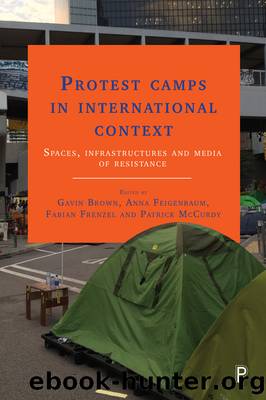
Author:unknow
Language: eng
Format: epub
Tags: Political Science, Human Rights, Political Process, Political Advocacy
ISBN: 9781447329411
Google: aaJEDgAAQBAJ
Goodreads: 32201637
Publisher: Policy Press
Published: 2017-03-29T12:56:02+00:00
TWELVE
Reoccupation and resurgence: indigenous protest camps in Canada
Adam J Barker and Russell Myers Ross
Introduction: a history of blockades
Disruption results in consequences
remember Kanenhstaton Caledonia
remember Gustafen Lake
remember Ipperwash
remember Oka
rememeber Alcatraz and Eagle Bay
remember Wounded Knee
everyday is remembrance day
everyday
(excerpt from âForeverâ by Janet Rogers, 2015)
The history of the settler states of North America, Canada and the United States, can be told through stories of Indigenous peoplesâ struggles to maintain their lands in the face of relentless colonial displacement and dispossession (Dunbar-Ortiz, 2014; Daschuck, 2013; Harris, 2004). As settler states have relentlessly driven railways and roads through Indigenous homelands, while restricting Indigenous nations onto reserves, fractions of their former land-bases, direct actions to violate those colonial spaces can be a powerful act of resurgence for Indigenous peoples (Alfred, 2005; Simpson, 2011). In response, blockading has become an important tactic through which Indigenous communities reassert their traditional forms of place-based culture and governance. Blockades run the gamut from flashmob-style disruptions of urban intersections, highways and commercial spaces (Barker, 2015, 48â50) to what Dene political scientist Glen Coulthard calls the rarest form of blockade action: the âmore-or-less permanent reoccupation of a portion of Native land through the establishment of a reclamation siteâ (Coulthard, 2014, 166).
These reoccupations or reclamation sites may be comparatively rare forms of resistance, but they also represent some of the most important moments in Indigenous activism in North America. In the USA, the history of the American Indian movement and the resurgence of tribal sovereignty struggles in the 1960s and 1970s is inextricably wrapped around occupations: Alcatraz in 1969â71, the Bureau of Indian Affairs building in Washington, DC in 1972, and the town of Wounded Knee in 1973 (Deloria, 1985; Smith and Warrior, 1997). These occupations continue into the present, with the Winnimum Wintu, an âunrecognisedâ tribe â meaning lacking official federal status â taking control of sacred river spaces in California (Fimrite, 2012), among many others.
Indigenous peoples in Canada are also a part of this history of anticolonial occupations. Canada is often falsely portrayed as a âpeacefulâ nation, built on treaties rather than conquest (Regan, 2010), but the response of settler governments and communities to Indigenous activists tells a different story. In 1995, Ontario Provincial Police violently raided Ipperwash Provincial Park, which had been occupied by members of the Stoney Point Ojibway band as part of a decades-old long land claim. During the raid, police fatally shot protester Dudley George.1 This standoff overlapped with an occupation near Gustafsen Lake in British Columbia, between August and September of 1995. Indigenous protesters occupied a private ranch on unceded Shushwap territory and the Canadian government responded by laying siege with federal police (Lambertus, 2004). And both of these protest camps followed on the heels of the most well-known standoff featuring blockades and occupations in Canadian history: the âOka Crisisâ of 1990.
This chapter examines three important reclamation sites, ranging from the spontaneous and relatively-short lived blockades of the Oka Crisis near the Kanesatake and Kahnawake Mohawk reserves in Québec, through the long-term Anishinaabe anti-clearcutting blockade at
Download
This site does not store any files on its server. We only index and link to content provided by other sites. Please contact the content providers to delete copyright contents if any and email us, we'll remove relevant links or contents immediately.
| Anthropology | Archaeology |
| Philosophy | Politics & Government |
| Social Sciences | Sociology |
| Women's Studies |
The Secret History by Donna Tartt(19088)
The Social Justice Warrior Handbook by Lisa De Pasquale(12190)
Thirteen Reasons Why by Jay Asher(8909)
This Is How You Lose Her by Junot Diaz(6886)
Weapons of Math Destruction by Cathy O'Neil(6279)
Zero to One by Peter Thiel(5801)
Beartown by Fredrik Backman(5754)
The Myth of the Strong Leader by Archie Brown(5507)
The Fire Next Time by James Baldwin(5444)
How Democracies Die by Steven Levitsky & Daniel Ziblatt(5218)
Promise Me, Dad by Joe Biden(5153)
Stone's Rules by Roger Stone(5087)
A Higher Loyalty: Truth, Lies, and Leadership by James Comey(4962)
100 Deadly Skills by Clint Emerson(4925)
Rise and Kill First by Ronen Bergman(4788)
Secrecy World by Jake Bernstein(4753)
The David Icke Guide to the Global Conspiracy (and how to end it) by David Icke(4717)
The Farm by Tom Rob Smith(4507)
The Doomsday Machine by Daniel Ellsberg(4490)
